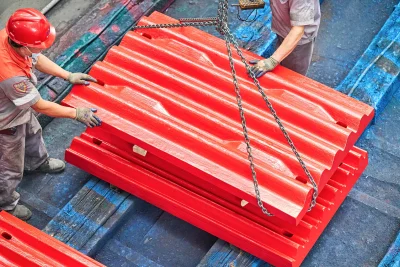
Jaw plates are among the most important wear parts in a jaw crusher. They are directly exposed to repeated impact, compression, and abrasion, so the right jaw plate can have a significant effect on crushing performance, wear life, maintenance intervals, and operating costs.
However, choosing a jaw plate is not simply a matter of finding a part that fits the crusher.
The correct choice should consider the crusher model, feed material, operating conditions, jaw plate profile, material grade, and manufacturing quality.
This guide explains the key factors to consider when selecting jaw crusher wear parts.
1. Start With the Jaw Crusher Model
The first step is to confirm the exact jaw crusher model.
Jaw plates are designed according to the geometry of the crushing chamber and mounting system. Two jaw plates may look similar but still have different:
- Overall dimensions
- Mounting arrangements
- Tooth profiles
- Thickness
- Hole positions
- Contact surfaces
- Curvature or working geometry
Before ordering, provide the supplier with as much information as possible, such as:
- Crusher model
- OEM part number
- Drawing
- Existing jaw plate sample
- Dimensions
- Photos
For customized production, drawings or samples are particularly useful because they allow the manufacturer to verify critical dimensions before casting.
2. Consider the Material Being Crushed
The feed material has a major influence on jaw plate wear.
A jaw crusher processing soft limestone does not experience the same wear conditions as a crusher processing hard and highly abrasive rock.
Important factors include:
- Material hardness
- Abrasiveness
- Feed size
- Moisture
- Impact load
- Material composition
For highly abrasive materials, wear resistance becomes particularly important.
For applications involving heavy impact, toughness becomes equally important.
This is why there is no single jaw plate material that is best for every crushing application.
3. Choose the Appropriate Jaw Plate Material
Material selection is one of the most important decisions when purchasing jaw crusher wear parts.
Two common material categories are high manganese steel and alloy steel.
High Manganese Steel Jaw Plates
High manganese steel has been widely used for jaw crusher wear parts because of its combination of toughness and wear resistance.
Under suitable impact conditions, manganese steel can undergo work hardening, increasing the hardness of the working surface during operation.
It can therefore be a suitable choice for applications involving significant impact.
Alloy Steel Jaw Plates
Alloy steel can provide different combinations of hardness, toughness, and wear resistance depending on its chemical composition and heat treatment.
For certain applications, alloy steel can provide a better balance for specific wear conditions.
The important point is that material should be selected according to the actual working conditions rather than simply choosing the hardest available material.
4. Hardness Is Not the Only Consideration
It is tempting to assume that a harder jaw plate will always last longer.
In reality, wear resistance and toughness need to be considered together.
A jaw plate needs sufficient hardness to resist abrasive wear, but it also needs adequate toughness to withstand repeated impact and mechanical loading.
If the material is too soft, abrasive wear may occur too quickly.
If the material has insufficient toughness, cracking or breakage can become a concern.
For this reason, jaw plate performance is related to the combination of:
Hardness + Toughness + Chemical Composition + Microstructure + Heat Treatment
5. Choose the Right Tooth Profile
Jaw plate tooth profile affects how material is gripped and crushed inside the chamber.
Different applications may require different profiles.
The appropriate profile can influence:
- Material grip
- Crushing efficiency
- Material flow
- Wear distribution
- Service life
When replacing an existing jaw plate, it is important to reproduce the required geometry accurately instead of simply producing a visually similar casting.
For customized jaw plates, the supplier should be able to work from drawings, samples, OEM part numbers, or detailed technical specifications.
6. Check Dimensional Accuracy
A jaw plate is a working component, not simply a piece of cast steel.
It must fit correctly inside the crusher.
Important dimensions may include:
- Overall length and width
- Thickness
- Mounting dimensions
- Hole positions
- Contact surfaces
- Tooth geometry
- Critical tolerances
Dimensional errors can create installation difficulties and may affect the working relationship between the fixed and swing jaw plates.
For this reason, machining and final dimensional inspection are important parts of jaw plate manufacturing.
7. Ask About Heat Treatment
Casting the correct chemical composition is only one part of manufacturing a quality jaw plate.
Heat treatment can have a major influence on the final mechanical properties and microstructure of wear-resistant castings.
When evaluating a jaw plate supplier, ask:
- What heat treatment process is used?
- How is temperature controlled?
- How is cooling controlled?
- How is quenching monitored?
- How are different material grades treated?
- Is metallographic inspection performed?
A controlled heat-treatment process helps improve consistency from batch to batch.
8. Look at the Entire Manufacturing Process
A reliable jaw plate should be produced through a controlled process rather than relying only on final inspection.
A typical manufacturing process includes:
Pattern Making → Core Making → Sand Preparation → Melting → Pouring → Heat Treatment → Cleaning → Machining → Final Inspection
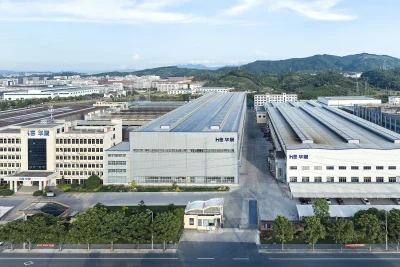
At Zhejiang Huasheng Metal Products Co., Ltd., the production system covers these major stages in-house.
During melting, chemical composition is checked against the required material specification before pouring. The process also includes heat treatment, machining, and final inspection.
This process-oriented approach is important for customers who require stable quality for repeated orders.
9. Consider the Supplier’s Manufacturing Capability
When purchasing jaw crusher wear parts, the supplier itself should also be evaluated.
A capable manufacturer should be able to answer questions about:
- Material grades
- Chemical composition
- Casting process
- Heat treatment
- Machining
- Dimensional inspection
- Metallographic inspection
- Production capacity
- Customized production
For overseas buyers, working directly with a foundry can also simplify technical communication.
Instead of communicating through several intermediaries, customers can discuss material, drawings, working conditions, and product improvements directly with the manufacturer.
10. Do Not Choose a Jaw Plate Based Only on Price
The cheapest jaw plate is not necessarily the lowest-cost solution.
A low-priced wear part can become expensive if it results in:
- Short service life
- Frequent replacement
- Unexpected cracking
- Installation problems
- Additional freight
- Maintenance downtime
A better approach is to consider the total cost over the service life of the jaw plate.
For mining and aggregate operations, the cost of unplanned crusher downtime can be much higher than the initial price difference between two wear parts.
Jaw Plate Selection Checklist
Before placing an order, confirm:
Crusher
- Is the crusher model correct?
- Is the part number correct?
- Are the dimensions confirmed?
- Is the tooth profile suitable?
Application
- What material is being crushed?
- What is the feed size?
- How abrasive is the material?
- What is the impact level?
Material
- Is high manganese steel suitable?
- Would alloy steel be more appropriate?
- Are hardness and toughness properly balanced?
Manufacturing
- Is chemical composition tested?
- Is heat treatment controlled?
- Is metallographic inspection available?
- Are dimensions inspected after machining?
Supplier
- Is the supplier a direct manufacturer?
- Can it produce according to drawings or samples?
- Can it support repeated orders?
- Can it provide other crusher wear parts?
Final Thoughts
Choosing the right jaw plate requires more than matching dimensions.
The best solution is the one that matches the crusher, feed material, operating conditions, material properties, and required service life.
A reliable manufacturer should also be able to demonstrate control over the complete production process, from melting and casting to heat treatment, machining, and final inspection.
For customers looking for customized jaw crusher wear parts, providing a crusher model, drawing, OEM part number, or existing sample is the best starting point.
Zhejiang Huasheng Metal Products Co., Ltd. manufactures customized jaw crusher wear parts for mining, quarrying, aggregate, and recycling applications. Contact our team with your drawing, sample, or crusher model to discuss the appropriate jaw plate solution.