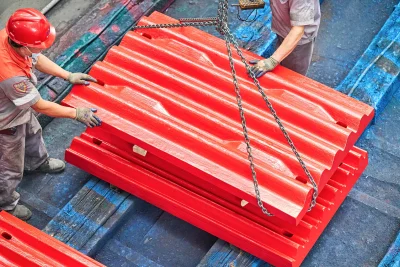
Choosing a crusher wear parts manufacturer is not simply about finding the lowest quotation.
For mining, quarrying, aggregate, recycling, and heavy equipment operations, wear parts directly affect maintenance schedules, equipment availability, and operating costs.
A supplier may offer a competitive price, but if the casting quality is inconsistent, dimensions are inaccurate, or service life is unpredictable, the actual cost can become much higher.
So, how should you evaluate a crusher wear parts manufacturer?
Here are the key factors to consider.
1. Is the Supplier a Manufacturer or a Trading Company?
This should be one of the first questions to ask.
A trading company may be able to supply crusher wear parts, but it may not control the actual casting process.
A direct foundry has control over key manufacturing stages such as:
- Pattern making
- Core making
- Melting
- Pouring
- Heat treatment
- Cleaning
- Machining
- Inspection
Direct communication with the manufacturer can make it easier to discuss technical requirements, material selection, quality problems, and product improvements.
For long-term procurement, this can also reduce communication layers.
2. Does the Manufacturer Control Chemical Composition?
Chemical composition is fundamental to the performance of cast wear parts.
Depending on the material grade, elements such as:
- Carbon
- Manganese
- Silicon
- Chromium
- Phosphorus
- Sulfur
can affect material properties and final performance.
A professional foundry should have a clear system for controlling the material composition.
At Zhejiang Huasheng Metal Products Co., Ltd., raw material recipes are controlled according to the specified material grade.
During melting, samples are taken for spectrometer analysis. The chemical composition is checked against the required specification before the molten metal proceeds to pouring.
This creates an important quality-control point before casting begins.
3. Does the Supplier Have Its Own Heat Treatment Capability?
Casting the correct material is only part of the process.
For many crusher wear parts, heat treatment has a significant influence on mechanical properties and microstructure.
When evaluating a supplier, ask:
- Is heat treatment performed in-house?
- How is furnace temperature controlled?
- How is cooling controlled?
- How is quenching monitored?
- Are different materials treated differently?
- Is the heat-treatment process recorded?
A supplier that controls heat treatment internally has greater control over the final properties of the casting.
4. Does the Manufacturer Perform Metallographic Inspection?
Appearance and dimensions cannot tell you everything about a casting.
Metallographic inspection provides information about the internal microstructure and can help verify whether the heat treatment has produced the intended result.
For critical wear parts, this provides an additional layer of quality control.
At Huasheng, metallographic inspection of the casting body is used as part of the quality-control process.
This is particularly relevant for wear parts that need to withstand repeated impact and abrasion.
5. Can the Supplier Control Dimensional Accuracy?
A wear part can have good material properties and still cause problems if the dimensions are incorrect.
Depending on the product, critical dimensions may include:
- Overall dimensions
- Mounting dimensions
- Bolt-hole positions
- Contact surfaces
- Working profiles
- Machined areas
- Critical tolerances
A reliable supplier should have the capability to inspect dimensions after casting and machining.
This becomes particularly important for customized and OEM replacement parts.
6. Can the Supplier Produce According to Drawings or Samples?
International buyers do not always purchase standard products.
You may need:
- OEM replacement parts
- Non-OEM equivalent parts
- Customized wear parts
- Modified profiles
- Specific material grades
- Drawing-based production
- Sample-based production
A capable foundry should be able to review the technical information available and determine whether the product can be manufactured accurately.
The more information you can provide, the easier it is for the manufacturer to verify the product before production.
7. Does the Manufacturer Understand Working Conditions?
A good wear parts supplier should not only ask:
“What part number do you need?”
They should also understand:
“What conditions will this part work under?”
Useful information includes:
- Equipment model
- Material being processed
- Feed size
- Abrasiveness
- Impact level
- Production requirements
- Current service life
- Existing wear pattern
This information can help the manufacturer evaluate whether the current material and design are appropriate.
In some applications, improving the product design or material selection can provide more value than simply reproducing the existing part.
8. Does the Supplier Offer Multiple Wear Part Categories?
For procurement teams, supplier consolidation can be valuable.
A mining operation may require several types of wear parts, including:
- Jaw plates
- Cone crusher mantles
- Cone crusher concaves
- Gyratory crusher wear parts
- Impact crusher wear parts
- Metal shredder hammers
- Mining shovel wear parts
- Mill liners
Working with a manufacturer capable of supplying multiple categories can reduce the number of suppliers that need to be managed.
It can also simplify:
Technical Communication → Quality Control → Order Management → Production Coordination → Logistics
9. Can the Supplier Handle Different Casting Sizes?
Wear parts can range from relatively small components to extremely large castings.
A manufacturer with different melting and casting capabilities can provide greater flexibility when customer requirements change.
Zhejiang Huasheng Metal Products Co., Ltd. operates multiple medium-frequency furnaces and has a maximum single casting weight capability of up to 30 tons.
This allows the foundry to support a broad range of wear-resistant castings.
10. Does the Supplier Have a Complete Quality-Control System?
Do not only ask whether a supplier performs final inspection.
Ask how quality is controlled throughout the manufacturing process.
A complete system should cover:
Before Production
- Raw material verification
- Material grade confirmation
- Pattern inspection
- Mold condition
During Production
- Melting
- Chemical composition
- Pouring
- Casting condition
- Heat treatment
- Cleaning
- Grinding
- Machining
Final Inspection
- Chemical composition
- Dimensions
- Mechanical properties
- Metallography
- Appearance
- Other required inspections
The goal is to prevent problems from moving to the next production stage.
11. Does the Manufacturer Focus on Batch-to-Batch Consistency?
A supplier may produce one excellent batch.
The more important question is:
Can they produce the next ten batches with similar quality?
For mining customers, consistency is often more valuable than a single successful order.
Stable production processes help customers establish more predictable maintenance schedules and reduce the risk associated with unexpected wear or failure.
This is why process monitoring should be considered when evaluating a long-term supplier.
12. Does the Supplier Understand Export Customers?
International procurement involves more than manufacturing.
A suitable export supplier should understand the importance of:
- Clear technical communication
- Drawing confirmation
- Production schedules
- Quality documentation
- Packaging
- Shipment coordination
- Repeat-order management
For customers purchasing wear parts internationally, reliable communication can be just as important as the casting itself.
A Practical Crusher Wear Parts Supplier Checklist
Before selecting a supplier, ask:
Manufacturing
- Are you a direct foundry?
- What casting process do you use?
- What is your maximum casting weight?
- What materials can you produce?
- Do you have in-house heat treatment?
Quality
- How do you control chemical composition?
- Do you perform metallographic inspection?
- How do you control dimensional accuracy?
- How do you monitor heat treatment?
- How do you ensure batch consistency?
Technical Support
- Can you manufacture from drawings?
- Can you manufacture from samples?
- Can you customize the material?
- Can you recommend materials based on working conditions?
Supply Capability
- Can you supply multiple wear-part categories?
- Can you handle trial orders?
- Can you support repeat orders?
- Can production capacity scale with customer demand?
If a supplier can provide clear answers to these questions, you are evaluating the manufacturer’s actual capability rather than simply comparing quotations.
Why Work Directly With a Foundry?
For some buyers, the biggest advantage of working directly with a foundry is not simply price.
It is control and communication.
Direct communication can make it easier to discuss:
- Product design
- Material selection
- Wear problems
- Quality issues
- Production schedules
- Product improvements
For customized wear parts, this direct technical communication can be particularly valuable.
About Zhejiang Huasheng Metal Products Co., Ltd.
Zhejiang Huasheng Metal Products Co., Ltd. is an export-oriented casting manufacturer specializing in wear-resistant castings for mining, crushing, recycling, and heavy equipment applications.
Our product range covers multiple wear-part categories, including:
- Jaw Crusher Wear Parts
- Cone Crusher Parts
- Gyratory Crusher Wear Parts
- Impact Crusher Wear Parts
- Metal Shredder Wear Parts
- Mining Shovel Wear Parts
- Mill Liners
- Customized Wear Castings
Our manufacturing process covers pattern making, core making, melting, pouring, heat treatment, cleaning, machining, and final inspection.
The objective is simple:
Control the process. Stabilize the quality. Build a reliable long-term supply chain for our customers.
Final Thoughts
The right crusher wear parts manufacturer should offer more than a competitive quotation.
Look at the complete picture:
Manufacturing Capability + Material Control + Heat Treatment + Quality Inspection + Technical Support + Supply Stability
A reliable supplier can help reduce more than the purchase price.
It can help reduce communication costs, quality risks, unexpected replacement, and supply-chain uncertainty.
If you are looking for a direct manufacturer of crusher wear parts, send us your drawing, sample, OEM part number, equipment model, or current wear problem.
Our team can review your requirements and discuss a suitable casting and material solution.