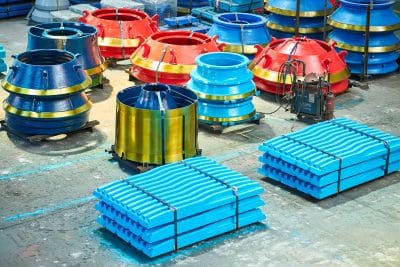
In mining operations, equipment downtime can be far more expensive than the price of a single wear part.
A worn jaw plate, cracked mantle, damaged concave, or failed crusher component can interrupt production and create unexpected maintenance work. For mining companies, aggregate producers, and equipment operators, this means that the real value of a wear part is not simply its purchase price—it is its ability to perform consistently throughout its expected service life.
This is why casting quality consistency is one of the most important factors when selecting a supplier of mining wear parts and crusher wear parts.
A reliable foundry should not only produce a qualified casting. It should have a complete quality control system designed to prevent quality problems before they become equipment problems.
Why Casting Quality Consistency Matters in Mining
Mining equipment operates under continuous impact, abrasion, vibration, and heavy loading.
Wear parts such as jaw plates, cone crusher mantles, concaves, side liners, and other crusher wear parts are designed to gradually wear during operation.
The problem begins when the actual performance of a casting is inconsistent.
For example, if one batch has significantly different hardness or microstructure from another, the service life of the same wear part may vary considerably.
This can lead to:
- Unexpected replacement
- Unplanned equipment shutdown
- Reduced crushing capacity
- Additional maintenance costs
- Increased inventory requirements
- Production schedule disruption
For a mine operating around the clock, even a small quality issue in a critical wear part can have a much larger operational impact.
Therefore, stable quality from batch to batch is just as important as the initial quality of the casting.
Quality Cannot Be Controlled Only at the Final Inspection
A common misconception is that casting quality can be guaranteed simply by inspecting the finished product.
In reality, final inspection can only identify problems that have already occurred.
A more reliable approach is to control quality throughout the entire manufacturing process.
For mining machinery wear parts, our quality control system covers:
Raw Materials → Mold & Core → Melting → Chemical Analysis → Pouring → Heat Treatment → Cleaning → Grinding → Machining → Final Inspection
Each stage has its own inspection requirements.
The purpose is simple:
Do not allow an unqualified product to move to the next production stage.
This creates a closed-loop quality control system rather than relying only on final inspection.
-
Raw Material Control: Quality Starts Before Melting
The quality of a casting starts with the materials that enter the furnace.
For alloy steel and high manganese steel wear parts, the chemical composition must be controlled according to the specified material grade.
Our raw materials include scrap steel and alloying materials, with the charge recipe strictly prepared according to the required grade.
Before production, materials are checked and managed according to the production requirements.
This is particularly important because elements such as:
- Carbon (C)
- Manganese (Mn)
- Silicon (Si)
- Chromium (Cr)
- Phosphorus (P)
- Sulfur (S)
can influence the final properties and microstructure of the casting.
For critical alloying elements and harmful impurities, controlling the chemical composition within the required range is an essential first step toward stable casting quality.
-
Spectrometer Analysis During Melting
Chemical composition should not be assumed simply because the correct materials were added.
During melting, samples are taken for spectrometer analysis.
The actual chemical composition is checked against the required material specification.
Carbon, manganese, silicon, phosphorus, sulfur, chromium, and other required elements are evaluated before the furnace is released for pouring.
For harmful elements such as phosphorus and sulfur, our process aims to keep their levels controlled below the specified limits.
Only when the chemical composition meets the required standard can the molten metal proceed to the next stage.
This approach helps reduce the risk of material composition becoming a source of batch-to-batch variation.
-
Mold and Core Inspection: Dimensional Accuracy Starts Here
A casting can have the correct chemical composition and still fail to meet customer requirements if the mold or core is inaccurate.
For this reason, mold and core quality are also part of the production control system.
Regular inspection helps control:
- Cavity dimensions
- Core positioning
- Wear of molds
- Casting geometry
- Critical dimensional features
For crusher wear parts, dimensional consistency is particularly important because the finished component must fit correctly into the customer’s equipment.
A small dimensional deviation in a critical area can affect installation, clearance, or the working condition of the component.
-
Controlled Pouring: Turning Molten Metal into a Reliable Casting
The pouring stage is another critical point in the casting process.
Once the chemical composition is confirmed, the molten metal must be poured under controlled process conditions.
The objective is to reduce casting defects and maintain consistency throughout the production batch.
Process control during pouring helps manage factors such as:
- Pouring temperature
- Pouring sequence
- Filling behavior
- Solidification conditions
For large and complex crusher wear parts, these factors become even more important because different sections of a casting may have different thicknesses and cooling behavior.
-
Heat Treatment: Controlling Hardness and Toughness
For many alloy steel and high manganese steel wear parts, casting is only the beginning.
Heat treatment has a major influence on the final mechanical properties of the component.
The objective is not simply to achieve high hardness.
A reliable wear part needs the right balance between:
Hardness + Toughness + Microstructure + Wear Resistance
If a component is too soft, it may wear prematurely.
If it is excessively hard without sufficient toughness, it may become more susceptible to cracking under severe impact.
Our heat treatment process includes controlled heating and different cooling methods according to material and product requirements.
The heat treatment workshop is equipped with electronic monitoring systems that record critical process information, including water temperature and water-entry timing.
The quenching pool has six temperature monitoring points for real-time water temperature tracking.
Two cooling towers are also used to maintain stable cooling conditions. Each tower can process approximately 500 tons of water per hour, supporting continuous heat treatment production.
-
Thermal Imaging Provides Additional Process Traceability
Large castings can be particularly challenging during heat treatment because of differences in section thickness and temperature distribution.
To improve process monitoring, our heat treatment trolleys are equipped with thermal imaging cameras.
The system records temperature information before the castings enter the quenching process.
This provides additional process data and allows the production team to better understand temperature conditions during heat treatment.
For large mining wear parts, additional process traceability helps support more consistent production.
-
Metallographic Inspection: Looking Beyond Surface Hardness
Hardness alone does not tell the complete story of a casting.
Two components can have similar hardness values but different microstructures—and therefore potentially different performance.
For this reason, we perform metallographic inspection of the casting body for every heat treatment batch.
Metallographic inspection helps evaluate the resulting microstructure and provides additional verification of the heat treatment process.
This is particularly valuable for wear parts that must withstand heavy impact and abrasion over long operating periods.
-
Equal-Thickness Test Blocks for Periodic Stability Verification
Quality control should also evaluate whether the production process remains stable over time.
Every three months, we produce equal-thickness test blocks matching the wall thickness of actual products.
These test blocks are used to evaluate the stability of the heat treatment process and related mechanical properties.
Why match the thickness?
Because casting thickness affects heat transfer and cooling behavior.
A test sample that does not represent the actual casting section may not accurately reflect the conditions experienced by the real product.
Using representative test blocks provides another way to verify process stability over time.
-
Quality Control Does Not Stop at Heat Treatment
After heat treatment, wear parts go through cleaning, grinding, machining, and final inspection.
Each stage has corresponding inspection requirements.
Final inspection can include verification of:
- Chemical composition
- Dimensions
- Surface condition
- Mechanical properties
- Metallographic structure
- Product specifications
The principle is straightforward:
Each process must be confirmed before the product moves to the next one.
This helps prevent defects from being carried forward through the production process.
How Quality Control Helps Reduce Unexpected Mining Downtime
No manufacturer can honestly guarantee that a mining operation will never experience downtime.
However, a controlled manufacturing process can significantly reduce the risk that wear part quality itself becomes an unexpected cause of downtime.
For mining customers, stable wear part quality can help provide:
More predictable replacement cycles
Consistent material properties and dimensions make wear behavior more predictable.
Fewer quality-related interruptions
Better process control reduces the risk of casting defects and abnormal premature failure.
More reliable equipment maintenance planning
When wear part performance is more consistent, maintenance teams can plan replacement more effectively.
Lower supplier management risk
Stable batch-to-batch production is especially important for customers purchasing wear parts repeatedly throughout the year.
From One Qualified Casting to Long-Term Supply
For a mining customer, receiving one good batch is not enough.
The real test of a foundry is whether it can produce the same level of quality repeatedly.
This becomes especially important when customers move from trial orders to long-term supply.
A reliable supplier needs:
- Stable raw material management
- Controlled alloy recipes
- Consistent melting processes
- Reliable heat treatment
- Process traceability
- Regular testing
- Experienced production personnel
- Complete inspection procedures
These systems work together to turn individual qualified castings into stable long-term production capability.
Why Choosing the Right Foundry Matters
When purchasing crusher wear parts, it can be tempting to compare suppliers primarily by unit price.
But the lowest casting price does not necessarily mean the lowest total cost.
If a wear part fails prematurely, the actual cost can include:
Replacement Part + Labor + Transportation + Maintenance + Lost Production + Emergency Inventory
For mining operations, lost production can be much more expensive than the original difference in casting price.
This is why procurement teams should evaluate a foundry based on total supply reliability, not only the quotation.
Questions worth asking include:
- How are raw materials controlled?
- How is chemical composition verified?
- How is heat treatment monitored?
- Is metallographic inspection performed?
- How is batch-to-batch consistency controlled?
- Can the supplier maintain quality as order volume increases?
- Can the supplier provide complete production and inspection records?
A Complete Manufacturing System for Mining Wear Parts
Our production system covers the complete casting process, from mold making and melting to heat treatment, machining, and final inspection.
Our melting capacity includes 3-ton, 5-ton, and 10-ton medium-frequency furnaces, allowing production to be arranged according to different casting sizes and order requirements.
We manufacture a range of mining machinery wear parts and crusher wear parts, including:
- Jaw plates
- Cone crusher mantles
- Cone crusher concaves
- Side liners
- Shredder hammers
- Other customized wear-resistant castings
The goal is not simply to produce a casting that passes inspection.
The goal is to establish a repeatable manufacturing process that helps customers receive stable-quality wear parts over the long term.
Conclusion: Stable Quality Is Part of Equipment Reliability
For mining companies, a wear part is part of a much larger production system.
When a crusher stops unexpectedly, the impact can extend far beyond the failed component.
That is why reliable casting quality control matters.
From raw material inspection and spectrometer analysis to controlled pouring, heat treatment monitoring, thermal imaging, metallographic inspection, and periodic testing, every stage contributes to the final reliability of a wear part.
A professional foundry should therefore be evaluated not only by what it can cast, but by how consistently it can cast it.
For customers sourcing jaw plates, mantles, concaves, crusher wear parts, mining wear parts, and customized alloy steel castings, stable manufacturing processes are the foundation for reliable long-term supply—and an important step toward reducing quality-related unexpected downtime.
SEO Keywords: mining wear parts, crusher wear parts, casting quality control, foundry quality control, jaw plates, crusher mantles, crusher concaves, alloy steel castings, mining machinery wear parts, wear resistant castings, casting manufacturer, crusher parts supplier
Suggested Meta Title:
Casting Quality Control for Mining Wear Parts | Reducing Unexpected Downtime
Suggested Meta Description:
Learn how a professional foundry controls raw materials, chemical composition, heat treatment, metallography and casting processes to improve the consistency of mining wear parts and reduce quality-related equipment downtime.