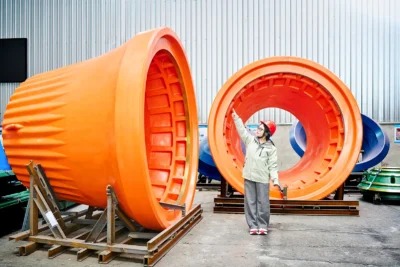
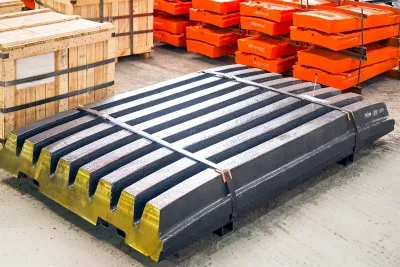
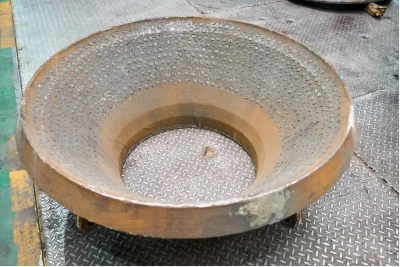
In the crushing production lines of industries such as mining, construction aggregate processing, and metallurgical smelting, cone crushers have become the core equipment for medium and fine crushing operations due to their efficient laminated crushing advantages. As a key wearing part of cone crushers, alloy steel concave (also known as fixed cone liner) directly determines the crushing efficiency, material particle shape quality, and equipment operation and maintenance costs. Fixed on the crusher frame, it works in coordination with the mantle (moving cone liner) to achieve material crushing through continuous extrusion and grinding. Its performance is directly related to the stable operation and economic benefits of the entire production line.
- Core Positioning and Working Principle of Alloy Steel Concave
Alloy steel concave is a fixed component of the crushing chamber of a cone crusher. It forms a symmetrical curved structure with the mantle installed on the high-speed rotating moving cone, together forming an efficient crushing space. Its working principle follows the typical “laminated crushing” mode: the motor drives the horizontal shaft to rotate, which drives the eccentric sleeve to operate through gears, and then drives the moving cone to perform regular circular swing, making the mantle continuously approach and move away from the stationary concave. Materials enter the gradually narrowing gap between the two from the upper feed port. Instead of being crushed at one time, they undergo multiple extrusions, grinding, and shearing, and finally form finished materials with uniform particle size and regular shape, which are widely suitable for scenarios requiring high finished product quality such as construction aggregates and ore processing.
Compared with concave made of ordinary materials, alloy steel concave achieves a qualitative improvement in key performances such as hardness, toughness, and wear resistance through reasonable alloy element ratio and precise heat treatment process. It can effectively withstand the impact and wear of high-hardness materials (such as basalt, granite, and non-ferrous metal ores), solve the pain points of traditional concave such as easy fracture, fast wear, and frequent replacement, and greatly reduce the equipment shutdown and maintenance costs.
- Main Material Classification and Performance Characteristics of Alloy Steel Concave
The core performance of alloy steel concave depends on the selection and ratio of alloy materials. At present, the mainstream materials in the industry are mainly high manganese steel series, and derived improved materials such as ultra-high manganese steel and composite alloy are also developed to adapt to different working conditions. The performance characteristics and applicable scenarios of various materials have their own focuses:
(I) High Manganese Steel Series Materials
High manganese steel is the basic and mainstream material for alloy steel concave, with the core representative being the Mn13 series (such as ZGMn13, Mn13Cr2). Its manganese content is about 13%, which has excellent toughness and work hardening characteristics. When subjected to high-frequency impact and extrusion, a hard hardened layer will quickly form on the surface to effectively resist wear, while the interior still maintains good toughness. Even when worn to a relatively thin state, it can bear large impact loads without breaking, avoiding secondary damage to the equipment caused by component fracture.
Among them, the Mn13Cr2 material adds chromium element on the basis of traditional Mn13, optimizes the chemical composition ratio, reduces the carbon and manganese content. It not only makes up for the defect of insufficient toughness of traditional high manganese steel, but also enhances the matrix wear resistance. Its service life is more than 30% longer than that of ordinary Mn13 material. It is widely used in medium and fine crushing operations of medium and large cone crushers, and is suitable for crushing medium-hardness materials such as granite and river pebbles.
(II) Ultra-High Manganese Steel Series Materials
Ultra-high manganese steel materials are represented by the Mn18 series (Mn18, Mn18Cr2), with the manganese content increased to about 18% and the carbon content also increased accordingly. The as-cast structure is austenite and carbides. After water toughening treatment at 1050℃, most of the carbides are dissolved in austenite, further improving the hardness and toughness of the material. Among them, the Mn18Cr2 material achieves grain refinement and grain boundary purification through composite modification treatment, and optimizes the casting solidification method, making the casting have higher hardness and stronger impact wear resistance. It is suitable for medium and large cone crushers, and can meet the crushing needs of ultra-high hardness materials such as basalt and diabase. Its service life is 1.5-2 times that of ordinary high manganese steel concave.
(III) Composite Alloy Materials
The new type of composite alloy concave uses high manganese steel or ultra-high manganese steel as the matrix, and composite inlays hard alloy or ceramic particles on the working surface to achieve dual improvement of “toughness + wear resistance”. The non-wearing surface maintains the excellent plasticity and impact toughness of the matrix, while the wearing surface has super wear resistance, which effectively reduces matrix wear. Its service life is 2-3 times that of traditional high manganese steel concave, and at the same time reduces the investment cost of casting wear. It is suitable for harsh working conditions with high wear and strong impact, such as ore crushing operations in large mines.
III. Manufacturing Process and Quality Control of Alloy Steel Concave
The production of high-quality alloy steel concave needs to go through six core links: “material ratio – smelting – casting – heat treatment – precision machining – inspection”. The precise control of each link is the key to ensuring product performance. The current mainstream manufacturing processes and quality control points in the industry are as follows:
(I) Core Manufacturing Processes
- Smelting Process: Medium frequency furnace smelting is adopted, using high-quality scrap steel, pig iron, and return scrap as raw materials. The ratio of alloy elements (manganese, chromium, carbon, etc.) is strictly controlled to ensure uniform chemical composition. At the same time, alloy materials such as ferrosilicon, ferromanganese, and ferrochrome are added to adjust the composition. After smelting, slag is removed and the mixture is left standing for 15-20 minutes to ensure the purity of the molten steel and avoid impurities affecting product performance.
- Casting Process: The mainstream adopts three methods: lost foam casting, quartz sand mold casting, and resin sand mold casting, which can be selected according to product specifications and working conditions. Among them, the new casting process effectively improves the casting density by optimizing the riser design (riser volume is larger than the mold cavity), adding riser spacers, and adopting high-frequency vibration (frequency > 2000r/min) process, avoiding casting defects such as shrinkage holes and shrinkage porosity, significantly improving product wear resistance and service life, which is nearly 5 times longer than that of traditional processes.
- Heat Treatment Process: This is the core link determining the performance of alloy steel concave. The high manganese steel series adopts water toughening treatment, heating the casting to 1045-1050℃, keeping it warm for a period of time, and then quickly cooling it with water, so that carbides are fully dissolved in austenite, eliminating casting internal stress and improving the toughness and wear resistance of the material. On this basis, the ultra-high manganese steel series adds composite modification treatment to further refine grains, optimize metallographic structure, and enhance impact resistance.
- Precision Machining and Inspection: After cooling, sand cleaning, and grinding, the casting is subjected to precision machining to ensure that the dimensional accuracy is perfectly matched with the cone crusher frame. At the same time, non-destructive testing (such as ultrasonic testing), hardness testing, metallographic analysis and other methods are used to check for hidden defects such as slag inclusions, air holes, and cracks, ensuring that the product quality meets industry standards and usage requirements.
(II) Key Quality Control Points
– Chemical Composition Control: Strictly control the sulfur and phosphorus content. Sulfur will increase the hot brittleness of the casting, and phosphorus will increase the cold brittleness, both of which will lead to easy fracture of the concave. They need to be controlled in an extremely low range. At the same time, the ratio of manganese, chromium, and carbon is accurately controlled to ensure the balance between material toughness and wear resistance.
– Casting Defect Control: Optimize casting process parameters, control the pouring temperature (1460-1480℃), adopt high-frequency vibration crystallization, reduce defects such as shrinkage holes, shrinkage porosity, and sand inclusions, and avoid defects becoming fatigue crack sources leading to early product failure.
– Heat Treatment Precision Control: Strictly control the heating temperature, holding time, and cooling rate, avoid cracks or performance degradation caused by uneven heating and too fast cooling, and ensure that the work hardening characteristics of the material are fully exerted.
- Application Scenarios and Selection Skills of Alloy Steel Concave
(I) Main Application Scenarios
Alloy steel concave is widely used in fields such as mine ore crushing, high-hardness rock crushing, and construction material crushing. It is suitable for various cone crushing equipment such as hydraulic single-cylinder cone crushers, composite cone crushers, and spring cone crushers. The specific application scenarios include:
- Mining Industry: Medium and fine crushing operations of iron ore, non-ferrous metal ore, basalt, granite and other ores, which is the core wear-resistant component in the second and third crushing links of the mine production line;
- Construction Aggregate Industry: Crushing and processing of river pebbles, quartz stones, construction waste and other materials, used for producing concrete aggregates, sand and gravel for road construction, etc., requiring regular finished product particle shape;
- Metallurgical and Cement Industry: Crushing treatment of metallurgical slag, cement clinker and other materials, adapting to working conditions with high wear and medium impact;
- Other Fields: Material crushing in chemical, electric power and other industries. Alloy steel concave can be customized and adapted according to material hardness and crushing requirements.
(II) Scientific Selection Skills
The core of selection is to match the working conditions, avoid “over-qualification” or “rapid failure due to inconsistent materials”. The specific selection points are as follows:
- Combine Material Characteristics: For crushing high-hardness and strong-impact materials (such as basalt and granite), prioritize Mn18Cr2 ultra-high manganese steel or composite alloy materials; for crushing medium-hardness and medium-impact materials (such as river pebbles and limestone), Mn13Cr2 high manganese steel materials can be selected to balance cost performance and service life;
- Match Equipment Parameters: Determine the size and specification of the concave according to the brand, model, and host number of the cone crusher to ensure perfect matching with the equipment, avoiding additional wear and failures caused by loose installation;
- Refer to Usage Scenarios: For large-scale production lines and continuous operation conditions, prioritize composite alloy or ultra-high manganese steel materials with strong wear resistance and long service life to reduce replacement frequency; for small-scale production lines and intermittent operation conditions, high manganese steel materials can be selected to control costs;
- Pay Attention to Customization Services: Choose manufacturers that support processing according to drawings and samples and on-site drawing customization. The product structure and material ratio can be optimized according to specific working conditions (such as material particle size and crushing efficiency requirements) to improve adaptability and service life.
- Common Faults and Maintenance Skills of Alloy Steel Concave
As a wearing part, alloy steel concave is prone to faults such as wear, cracks, and looseness during long-term high-load work. Improper maintenance will shorten its service life and affect production efficiency. Combined with industry practice, common faults and maintenance skills are as follows:
(I) Common Faults and Causes
- Wear Faults: Divided into uniform wear (uniform thinning of the overall contact surface) and uneven wear (local pits and grooves). The main causes include excessively high material hardness, uneven feeding, improper adjustment of the discharge port, or inconsistent material selection with working conditions;
- Crack and Fracture Faults: Initially manifested as microcracks, which may develop into fractures in the later stage. The main causes include material casting defects (slag inclusions, air holes), substandard heat treatment, “iron passing” (iron blocks and other uncrushable objects entering the crushing chamber), excessive feeding or loose installation, leading to sudden increase in local stress;
- Loosening Faults: Loosening of fasteners (U-bolts) leads to deviation of the concave position, abnormal vibration and fretting wear during operation. The main causes include uncleaned mating surfaces during installation, failure to level and align, or failure to timely tighten loose fasteners after long-term operation.
(II) Daily Maintenance Skills
- Standard Operation: Ensure uniform feeding, avoid excessive one-time feeding and unbalanced loading, and eliminate over-specification materials and “iron passing” from entering the crushing chamber; reasonably adjust the discharge port to avoid long-term operation of the equipment in an excessively tight or loose state and reduce local overload;
- Regular Inspection: Adopt a combination of visual inspection, auditory inspection, and tactile inspection to regularly check the wear degree of the concave, whether there are cracks on the surface, and whether the fasteners are loose. Use a strong light flashlight and magnifying glass to assist in checking for micro-defects, and handle problems in a timely manner to avoid fault expansion; touch and inspect after the machine is shut down and cooled to perceive whether there is local overheating, abnormal vibration, etc.;
- Correct Installation: Clean the sundries and oil stains on the mating surface during installation, ensure that the concave is leveled and aligned, the zinc alloy casting is full, and the fasteners are tightened in place; when replacing new parts, ensure that the specifications are consistent with the old parts, and conduct a test run after installation to check the operation stability;
- Reasonable Storage: Unused concave should be stored in a dry and ventilated environment to avoid moisture and corrosion and prevent the material performance from declining; avoid collision and extrusion during storage to protect the surface accuracy and integrity;
- Timely Replacement: When the wear amount of the concave reaches the design limit, or serious cracks and fractures occur, replace it in a timely manner to avoid equipment failure or substandard material particle shape caused by component failure. At the same time, record the replacement cycle and optimize the selection and maintenance plan.
- Industry Development Trends and Future Outlook
With the development of mining, construction and other industries towards scale, efficiency, and greenization, the performance requirements for crushing equipment are constantly improving. As a core wearing part, alloy steel concave also presents three development trends:
First, material upgrading. By adding trace elements such as molybdenum and rare earth lanthanum, optimizing the alloy ratio, further improving the wear resistance, toughness, and corrosion resistance of the material, and reducing the alloy dosage to achieve “lightweight and high performance”; second, process innovation. Promote advanced processes such as lost foam casting and high-frequency vibration casting, combined with intelligent detection technology, to improve the stability of product quality and reduce casting defects; third, customization and intelligence development. Combine specific working conditions to provide personalized material ratio and product structure design, and integrate Internet of Things technology to realize real-time monitoring of the wear state of the concave, early warning of faults, reduction of downtime, and reduction of operation and maintenance costs.
As the “cornerstone” of cone crushing production, the performance improvement of alloy steel concave directly promotes the efficiency upgrading of the crushing industry. In the future, with the continuous breakthrough of wear-resistant material technology and casting technology, alloy steel concave will develop towards longer service life, higher adaptability, and lower operation and maintenance costs, providing strong support for the green and efficient development of industries such as mining and construction aggregate processing.