As a professional mining and construction wear parts supplier based in Wuyi, Zhejiang, China, we’ve spent over 15 years mastering the art of material selection for wear-resistant components. For suppliers, choosing the right material isn’t just about cutting costs or meeting basic standards—it’s about delivering parts that perform reliably in harsh working conditions, reducing downtime for clients, and building long-term trust. The wrong material choice can lead to frequent part failures, unhappy customers, and damaged brand reputation. In this blog, we’ll share our practical insights on how suppliers can select the optimal material for mining and construction wear parts, based on real-world scenarios and industry expertise.
First, let’s be clear: there’s no “one-size-fits-all” material for wear parts. Every application—from crushing hard ore to recycling scrap metal, from excavating in humid climates to working in high-temperature quarries—requires a material tailored to its unique challenges. The key is to balance three core factors: abrasion resistance, impact resistance, and cost-effectiveness. Below, we break down the critical steps suppliers should follow, along with our hands-on experience from manufacturing in Wuyi’s industrial hub, where access to premium raw materials and advanced foundry technology helps us refine our material selection process.
Step 1: Understand the Client’s Working Environment (The Foundation of Material Selection)
Before selecting any material, suppliers must dig deep into the client’s specific working conditions—this is where true professionalism shines. Many novice suppliers skip this step and opt for “popular” materials, only to deliver parts that fail prematurely. Here’s what we focus on when consulting with clients:
Abrasion Intensity: Is the part exposed to fine, abrasive particles (like sand or gravel) or large, sharp debris (like rock fragments)? High-abrasion environments demand materials with high hardness and wear resistance, while moderate abrasion can be handled with more cost-effective options.
Impact Load: Will the part endure heavy impacts (e.g., jaw crusher plates crushing large boulders) or low-impact, continuous wear (e.g., loader bucket liners)? Impact-prone parts need materials with good toughness to avoid cracking, even under sudden stress.
Operating Temperature: Extreme heat (e.g., desert quarries) or cold (e.g., northern mining sites) can affect material performance. For example, some alloys become brittle in low temperatures, while others lose hardness in high heat.
Chemical Exposure: Are the parts in contact with corrosive substances (e.g., acidic ore or saltwater in coastal construction)? Corrosion-resistant alloys are essential here to prevent premature degradation.
For example, a client in Southeast Asia’s tropical mines once approached us for jaw crusher plates that kept failing after just 2 weeks. After learning their mines had high humidity and abrasive iron ore, we switched from standard high manganese steel to a custom alloy with added chromium—this increased the part’s service life to 3 months, solving their problem. This is why understanding the environment is non-negotiable.
Step 2: Master the Key Wear-Resistant Materials (And Their Best Uses)
There are three primary material categories for mining and construction wear parts, each with distinct properties and applications. As a supplier with a factory in Wuyi—home to a strong supply chain for wear-resistant metals—we’ve tested and refined these materials to match different client needs. Here’s a breakdown of our go-to options, with practical use cases:
1. High Manganese Steel (ZGMn13, ZGMn18, ZGMn22)
High manganese steel is the workhorse of wear parts. Based on different manganese content, the commonly used grades are mainly ZGMn13, ZGMn18, and ZGMn22. All three possess excellent toughness and work hardening properties, but differ in performance focus, making them suitable for various working conditions. Among them, ZGMn13, as the basic grade, is the most widely used. When subjected to impact, its surface hardens (hardness can reach 55-60 HRC) while the core remains tough, effectively preventing cracking. ZGMn18 belongs to the ultra-high manganese steel series, with a manganese content increased to about 18%. It features faster work hardening speed, with a surface hardness of over 550 HBW after hardening—its wear resistance is 2-3 times that of ZGMn13. It also has good toughness and low magnetic permeability, making it suitable for more severe impact and wear scenarios. ZGMn22 is the grade with the most outstanding wear resistance among high manganese steels, with a manganese content as high as 22%. It boasts further improved plasticity and toughness, as well as a deeper work hardening layer, enabling it to maintain stable performance under extreme working conditions of strong impact and high wear, and is not prone to issues such as cracking and excessive wear.
The core performance comparison of the three is clear, facilitating suppliers to accurately select materials according to client working conditions: ZGMn13 focuses on cost-effectiveness, balancing toughness and wear resistance; ZGMn18 focuses on the dual improvement of wear resistance and toughness, suitable for medium-high impact and high wear scenarios; ZGMn22 focuses on adapting to extreme working conditions, performing better in strong impact and high abrasion environments. All three need to be under impact load conditions to give full play to their work hardening properties and achieve optimal wear resistance—this is one of the core points in high manganese steel selection.
Best Applications: Combined with their performance differences, they are accurately matched to different working conditions: ZGMn13 is suitable for medium impact and medium wear scenarios, such as jaw crusher liners, cheek plates, toggle plates, and shredder hammers for metal scrap recycling. 60% of our crusher parts use ZGMn13, as it perfectly balances durability and cost-effectiveness. ZGMn18 is suitable for medium-high impact and high wear scenarios, such as liners for large jaw crushers and impact crushers, as well as mine equipment parts with low magnetic requirements. It is particularly suitable for hot, humid, and high-abrasion mine environments, effectively extending part service life. ZGMn22 is suitable for strong impact and extreme wear scenarios, such as cone crusher liners in large mines, heavy-duty shredder hammers, and hydraulic bucket teeth. It is ideal for processing extremely hard and abrasive ores (e.g., basalt, granite) and crushing operations with high impact loads. Note: All three are not suitable for low-impact, high-wear environments (e.g., fine sand crushing), as they cannot harden sufficiently and will wear quickly. Among them, ZGMn18 and ZGMn22 have slightly higher costs than ZGMn13 due to their higher manganese content. When selecting materials, it is necessary to balance working conditions and client budgets.
2. High Chrome Iron (Cr15-Cr20)
High chrome iron is a premium material for high-abrasion scenarios. It has exceptional hardness (60-65 HRC) and excellent wear resistance, thanks to its chromium carbide content. Unlike high manganese steel, it doesn’t require impact to harden—making it perfect for parts that experience continuous, low-impact abrasion.
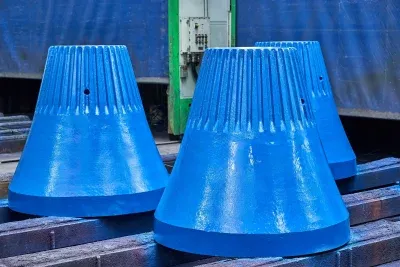
Best Applications: Cone crusher concaves and mantles, screen plates, and loader bucket liners for quarrying and mineral processing. We often recommend Cr15 for clients processing hard, abrasive ores (e.g., granite or basalt), as it outperforms high manganese steel in these conditions. The tradeoff? It’s less tough than high manganese steel, so it’s not ideal for high-impact parts (it may crack under heavy blows).
3. Custom Wear-Resistant Alloys
For complex or extreme environments, off-the-shelf materials won’t cut it. As a professional supplier, we develop custom alloys by adjusting the ratio of manganese, chromium, nickel, and molybdenum to meet specific client needs. This is where our R&D capability—strengthened by partnerships with Chinese research institutions—sets us apart.
Best Applications: Parts for extreme conditions, such as hydraulic shovel undercarriage in high-temperature mines or shredder grates for corrosive metal scrap. For example, we developed a nickel-chromium-molybdenum alloy for a client in Africa’s desert mines, which improved part service life by 50% compared to standard high chrome iron.
Step 3: Balance Quality, Cost, and Lead Time (The Supplier’s Secret to Success)
Professional suppliers don’t just choose the “best” material—they choose the right material for the client’s budget and timeline. Here’s how we strike this balance at our Wuyi factory:
Avoid Over-Engineering: If a client’s application only requires moderate abrasion and impact, using high chrome iron (a premium material) or ZGMn18, ZGMn22 (high-end grades of high manganese steel) will unnecessarily increase costs. We always recommend the most cost-effective material that meets their performance needs—for example, ZGMn13 for small-scale quarries instead of ZGMn18, ZGMn22 or custom alloys.
Leverage Local Supply Chains: Being based in Wuyi, Zhejiang, we have direct access to high-quality raw materials (e.g., high-purity manganese and chromium) at competitive prices. This allows us to offer premium materials without inflating costs, a key advantage for global clients.
Consider Lead Time: Custom alloys require longer R&D and production time. If a client needs parts quickly, we prioritize readily available materials (like ZGMn13, ZGMn18, ZGMn22, Cr15) while adjusting minor details (e.g., heat treatment) to improve performance.
Step 4: Test and Validate (Don’t Cut Corners on Quality)
Even the most well-researched material choice needs testing. Professional suppliers never skip this step—we conduct rigorous tests to ensure the material performs as expected. At our Wuyi factory, every batch of material undergoes:
Chemical Composition Analysis: To verify the correct ratio of metals (e.g., 11%-14% manganese in ZGMn13, approximately 18% manganese in ZGMn18, and approximately 22% manganese in ZGMn22), ensuring the performance of different grades of high manganese steel meets the requirements of corresponding working conditions.
Hardness Testing: To ensure the material meets the required HRC rating.
Impact Testing: To confirm toughness (critical for high-impact parts).
Field Testing: We test sample parts in real working environments (e.g., our own test quarry) to validate performance before mass production.
This testing process not only ensures quality but also helps us refine our material selection over time. For example, after field testing, we found that adding 2% molybdenum to our high chrome iron improved its toughness, making it suitable for light-impact applications—something we now offer to clients as an upgrade.
Why Material Selection Matters for Suppliers (And Your Clients)
As a supplier based in Wuyi, Zhejiang, China—one of the world’s key hubs for wear parts manufacturing—we’ve learned that material selection is the difference between being a “vendor” and a “trusted partner.” Clients don’t just buy wear parts; they buy reliability, reduced downtime, and peace of mind. By taking the time to understand their needs, master material properties, and test rigorously, we deliver parts that exceed expectations.
Whether you’re a supplier looking to improve your material selection process, or a mining/construction company searching for a partner who understands material science, Zhejiang Huasheng Metal Products Co., Ltd. is here to help. With our 15+ years of experience, advanced Wuyi factory, and commitment to quality, we select the right material for every application—ensuring your equipment runs smoothly, and your business thrives.
Contact us today to discuss your wear parts needs, and let our team of material experts recommend the perfect solution for you.